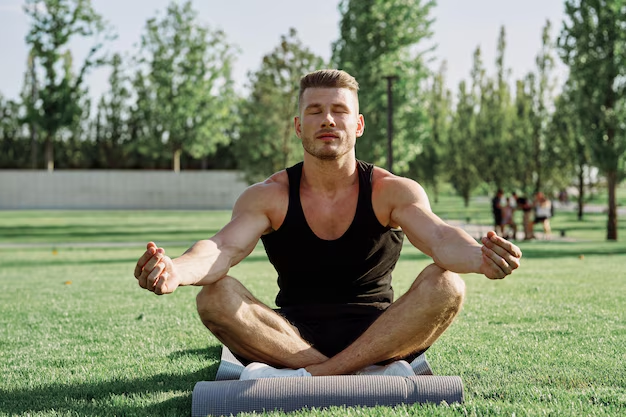
Simple Mindfulness Exercises for Everyday Life
Mindfulness has become one of the most widely recommended tools for managing stress and anxiety — but it's often presented as something that requires apps, cushions, or a quiet hour you don't have. The reality is more practical. Mindfulness is a skill you can practice in small, ordinary moments, and the cumulative effect can shift how you relate to stress over time.
This guide explains what mindfulness actually is, how it works, and which simple exercises tend to fit into real daily life.
What Mindfulness Actually Means
Mindfulness is the practice of paying deliberate attention to the present moment — what you're experiencing right now — without judging it as good or bad. That sounds simple, but it runs against how most minds operate. Left to their own devices, minds tend to rehearse the future or replay the past, which is a significant driver of both anxiety and chronic stress.
The practice doesn't ask you to empty your mind or feel calm. It asks you to notice what's happening — including stress, distraction, or discomfort — rather than running from it or getting swept away by it. That noticing, done repeatedly, is where the benefit builds.
Why Small, Consistent Practice Tends to Work Better Than Long Sessions
One of the most common misconceptions is that mindfulness requires a dedicated sitting practice of 20 or 30 minutes. Research and clinical experience both point to a more accessible truth: frequency often matters more than duration, especially for beginners.
A few minutes of genuine, focused attention several times a day tends to be more effective for most people than one long session squeezed in reluctantly. This matters because it lowers the barrier to starting — and starting consistently is what builds the habit.
Simple Mindfulness Exercises You Can Use Today 🧘
1. The Breath Anchor
This is the most fundamental mindfulness technique, and for good reason — your breath is always available.
How it works: Choose a specific sensation to focus on — the feeling of air entering your nostrils, the rise of your chest, or the expansion of your belly. Set a timer for two to five minutes. Each time your attention wanders (it will), gently return it to that sensation without frustration.
What makes it useful: You're not trying to slow your breathing or force relaxation. You're practicing the act of noticing distraction and returning — which is the core skill. Over time, this gets easier and faster to deploy in stressful moments.
Good for: Morning routines, lunch breaks, before difficult conversations, or any moment of transition.
2. The Body Scan
A body scan involves moving your attention deliberately through different parts of your body, noticing sensation without trying to change anything.
How it works: Start at your feet and slowly move upward — calves, knees, thighs, abdomen, chest, hands, arms, shoulders, neck, face. Spend a few seconds at each area, just noticing. Tension? Warmth? Numbness? You don't need to do anything about what you find.
What makes it useful: Many people carry stress physically — tight shoulders, a clenched jaw, a knot in the stomach — without realizing it until it becomes pain. Regular body scans build interoceptive awareness, your ability to read your own body's signals earlier.
Good for: Winding down before sleep, or as a mid-afternoon reset at a desk.
3. Mindful Observation (the "One Thing" Practice)
Choose any ordinary object — a cup of coffee, a plant, your own hand — and give it your full attention for one to two minutes.
How it works: Look at it as if you've never seen it before. Notice its color, texture, weight, temperature, smell. Let your senses do the work without narrating or evaluating.
What makes it useful: This exercise trains the same attention muscle as formal meditation, but it fits inside daily routines without requiring any extra time. It also creates a natural pattern interrupt — a way of stepping out of anxious thought loops.
Good for: Anyone who resists "sitting still" but wants to build awareness gradually.
4. Mindful Walking
Walking is one of the most underused mindfulness vehicles, particularly because people already do it.
How it works: During a walk — even just from your car to a building — direct attention to physical sensation rather than your phone or your thoughts. Notice the feeling of your foot meeting the ground, the rhythm of your stride, the temperature of the air on your skin. When thoughts arise, acknowledge them and return to the sensations of movement.
What makes it useful: It links mindfulness to an activity many people find easier than stillness. For those with restlessness or physical anxiety, movement-based practice can feel more accessible.
Good for: Commutes, lunch walks, or transitions between tasks.
5. The STOP Technique
This is a structured micro-practice designed for high-stress moments rather than quiet settings.
How it works:
- S — Stop what you're doing
- T — Take one conscious breath
- O — Observe what's happening (thoughts, feelings, body sensations)
- P — Proceed with awareness
What makes it useful: It creates a brief gap between stimulus and response — the space where reactive behavior can be replaced by intentional choice. This is particularly relevant to anxiety-driven reactions, impulsive decisions under stress, or conflict situations.
Good for: Any moment when you notice you're escalating, overwhelmed, or running on autopilot.
How Different People Experience These Practices
Not everyone finds the same entry point. What works well varies based on several factors:
| Factor | What It Might Influence |
|---|---|
| Anxiety level | High anxiety may make breath focus initially distressing; body scans or movement may feel safer |
| Lifestyle and schedule | People with unpredictable days often do better with woven-in practices than timed sessions |
| Prior experience | Complete beginners often benefit from guided audio; experienced practitioners may prefer silence |
| Physical health | Chronic pain or health conditions can affect body scan experiences significantly |
| Temperament | Some people take to stillness immediately; others build the habit more gradually through movement |
This spectrum matters because there's no universally "best" exercise. The most effective practice is one you'll actually return to.
Common Challenges — and What They Mean 🌱
"My mind won't stop wandering." This is not a sign you're doing it wrong. A wandering mind that returns is the entire exercise. Each return is a repetition, like a bicep curl for attention.
"I fall asleep during body scans." This is common, especially when practicing lying down. It often signals genuine rest deprivation rather than failure. Adjusting posture — seated rather than supine — usually helps.
"I feel more anxious when I focus on my breath." This happens for some people, particularly those with certain anxiety profiles or trauma histories. It's a meaningful signal worth discussing with a mental health professional rather than pushing through.
"I can't find time." The honest response: most of these exercises take under five minutes. The barrier is usually motivation or habit formation, not time. Attaching a practice to an existing habit — morning coffee, the daily commute — tends to work better than carving out new time.
What Mindfulness Can and Can't Do
Mindfulness is well-supported as a tool for reducing stress reactivity, improving emotional regulation, and building present-moment awareness. It's a core component of several evidence-based therapeutic approaches, including Mindfulness-Based Stress Reduction (MBSR) and Mindfulness-Based Cognitive Therapy (MBCT).
It is not a substitute for professional mental health treatment. People navigating significant anxiety disorders, depression, trauma, or other clinical conditions should consider these practices as possible complements to professional care — not replacements for it. What mindfulness can offer, for whom, and how quickly it helps varies considerably from person to person.
What to Evaluate Before Choosing Where to Start
- Which moments in your day already involve transition, waiting, or routine movement?
- Do you find stillness calming or agitating?
- Are you looking for a long-term habit or a quick tool for acute stress moments?
- Have you tried mindfulness before and found a particular format didn't suit you?
Your answers point toward which of these exercises is the most natural starting point — and which you're most likely to stick with long enough to feel the difference.