How to Build Healthy Habits in Children: A Practical Guide for Families
Healthy habits formed in childhood tend to stick. The routines kids establish around food, movement, sleep, and emotional wellbeing don't just affect their health today — they shape the patterns they carry into adulthood. The good news is that building those habits doesn't require perfection. It requires consistency, environment, and a realistic understanding of how children actually learn.
Why Childhood Is a Critical Window for Habit Formation
Children's brains are highly adaptable, especially in the early years. Repeated behaviors get reinforced through neural pathways, which is why habits formed young — both good and bad — can become deeply ingrained over time.
Habit formation in children works differently than in adults. Kids don't build habits through willpower or conscious decision-making. They build them through repetition, observation, and environment. What they see modeled at home, what's available to them, and what feels normal in their daily routine all matter more than instruction alone.
This is why "do as I say, not as I do" rarely works with children. The habits adults demonstrate tend to have more influence than the ones they prescribe.
The Core Pillars of Healthy Habits for Kids 🌱
Healthy habit formation in children generally clusters around a few key areas. The right balance and emphasis will vary depending on the child's age, developmental stage, temperament, and family circumstances.
1. Nutrition and Eating Patterns
Healthy eating habits aren't primarily about specific foods — they're about the relationship with food children develop over time.
Key factors that shape healthy eating habits include:
- Consistent meal structure — Regular mealtimes help children recognize hunger and fullness cues, rather than eating reactively or out of boredom.
- Exposure and variety — Children often need repeated exposure to a new food before accepting it. Early and frequent exposure to diverse foods tends to produce more flexible eaters.
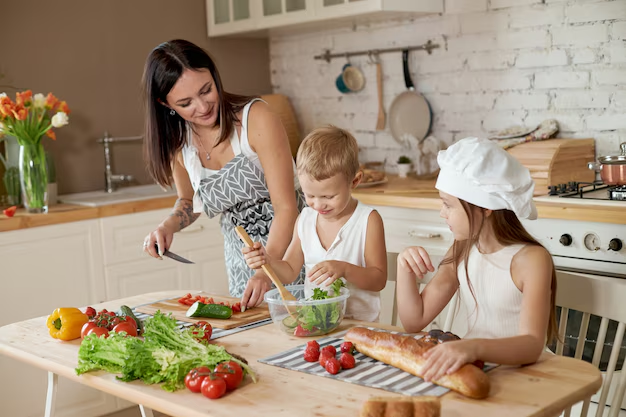
- Eating environment — Shared family meals, minimal screens at the table, and a low-pressure atmosphere around food are associated with better eating patterns than reward-based or coercive approaches.
- Modeling — Children pay close attention to what adults around them eat and how they talk about food.
What works for a toddler who's a highly selective eater will look different from what works for a school-age child navigating a cafeteria. Age, developmental stage, and any underlying sensory or medical factors all shape what approach makes sense.
2. Physical Activity and Movement
Children are naturally inclined toward movement — the challenge is often preserving and channeling that inclination as screen time, structured schedules, and sedentary environments compete for their attention.
Structured versus unstructured activity both play a role:
| Type | Examples | Benefits |
|---|---|---|
| Structured activity | Sports teams, swim lessons, dance class | Skill-building, teamwork, discipline |
| Unstructured play | Free outdoor play, imaginative games | Creativity, self-regulation, intrinsic motivation |
| Incidental movement | Walking to school, active chores | Builds movement into daily routine naturally |
The goal isn't to create elite athletes — it's to help children associate movement with enjoyment rather than obligation. How a family achieves that depends on available resources, the child's personality, and local environment.
3. Sleep Habits 😴
Sleep is foundational to almost every other aspect of children's health — mood, focus, immune function, growth, and behavior regulation all depend on adequate, quality sleep.
Consistent sleep habits typically involve:
- A predictable bedtime and wake time, even on weekends
- A wind-down routine that signals to the body that sleep is coming (this might include bath, reading, or quiet play — the specific routine matters less than its consistency)
- A sleep environment that limits light, noise, and screen stimulation close to bedtime
The amount of sleep children need varies by age and individual, and pediatric guidelines are updated periodically. A child's pediatrician is the right resource for age-specific guidance. What's consistent across the research is that regularity and environment matter enormously regardless of exact hours.
4. Emotional and Mental Wellbeing Habits
Healthy habits aren't only physical. The practices children develop around managing emotions, navigating stress, and building relationships are equally foundational.
Key habits in this area include:
- Naming emotions — Teaching children to identify and label feelings (rather than suppress or act them out) is a skill that requires consistent modeling and practice.
- Problem-solving routines — When children face conflict or frustration, guiding them through a process (rather than solving it for them) builds resilience over time.
- Downtime and boredom tolerance — Overscheduled children miss the opportunity to develop self-directed thinking and the ability to self-regulate without external stimulation.
- Connection rituals — Regular one-on-one time, family meals, or bedtime conversations create the relational foundation that supports emotional health.
How Children Actually Adopt Habits: What the Research Consistently Shows
Understanding how habits form helps parents and caregivers work with children's natural tendencies rather than against them.
Environment design beats willpower. If healthy food is visible and accessible, children eat more of it. If screens are in bedrooms, sleep suffers. Structuring the physical environment removes the need for constant negotiation or discipline.
Routine creates automatic behavior. When healthy behaviors are embedded in predictable sequences — breakfast after waking, outdoor time after school, teeth brushing before bed — they become defaults rather than decisions. The less a behavior requires active motivation, the more reliably it happens.
Positive reinforcement outperforms punishment. Acknowledging and praising specific healthy behaviors ("I noticed you chose the apple without being reminded") tends to be more effective at sustaining habits than punishing their absence. The goal is helping children internalize the value of the behavior, not perform it for reward.
Autonomy accelerates adoption. Children who have some age-appropriate choice in their habits — which vegetable they pick, which sport they try, what their wind-down routine looks like — are more likely to feel ownership over those habits. Control battles tend to produce the opposite effect.
Variables That Shape What Works for Your Child 🧒
No single approach works for every family. The factors that most influence what strategies will be effective include:
- Child's age and developmental stage — Toddlers, school-age children, and adolescents respond to entirely different approaches. What works at five often doesn't work at twelve.
- Temperament and personality — A highly sensitive child, an intense child, or a child with a slow-to-warm disposition will need different levels of preparation, predictability, and choice.
- Existing habits and household culture — Introducing change into an established family routine requires more scaffolding than building habits from the start.
- Any underlying health or developmental considerations — Children with ADHD, sensory processing differences, anxiety, or other conditions may require adapted approaches, and guidance from healthcare providers becomes especially important.
- Family schedule and resources — The best habit strategy is one that's realistic to sustain given actual time, budget, and energy constraints.
When to Involve a Professional
Some challenges around children's habits warrant professional input rather than trial-and-error at home.
Consider speaking with your child's pediatrician, a registered dietitian, or a child psychologist if:
- A child's eating habits are significantly restricting their nutrition or causing serious anxiety around food
- Sleep problems are persistent and affecting daily functioning
- Behavioral or emotional challenges are making routine-building consistently difficult
- You're unsure whether what you're observing is typical development or something worth evaluating
The landscape of healthy habit-building is well understood. How it applies to your specific child — with their particular temperament, health history, and family context — is exactly the kind of question a qualified professional is equipped to help you navigate.