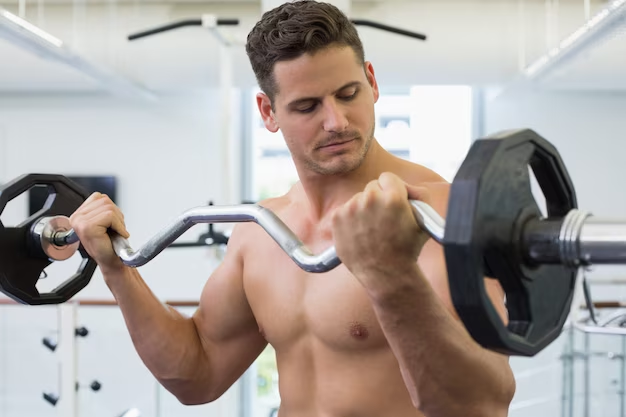
How to Avoid Injury When Lifting Weights
Strength training is one of the most effective things you can do for your long-term health — but it comes with real injury risk when done carelessly. The good news is that most lifting injuries aren't accidents. They're the predictable result of identifiable mistakes, and they're largely preventable with the right approach.
Here's what you need to understand about staying safe under the bar.
Why Lifting Injuries Happen in the First Place
Most weight training injuries fall into one of two categories: acute injuries (something goes wrong in a single moment) and overuse injuries (gradual damage that builds over time).
Acute injuries — a pulled muscle, a tweaked shoulder, a strained lower back — typically happen when a load exceeds what the body can safely handle at that moment. Overuse injuries develop more slowly, often from repeating a flawed movement pattern thousands of times or never giving the body enough time to recover.
Understanding which type you're dealing with — or trying to prevent — shapes how you train.
The Foundation: Form Before Load 💪
Technique is the single most important injury-prevention tool in strength training. No amount of warming up, stretching, or recovery work compensates for consistently poor movement mechanics.
The core principle: your body should move through a full, controlled range of motion with proper joint alignment before you add meaningful resistance. Loading a compromised position — a rounded lower back during a deadlift, knees caving during a squat, a flared elbow on a bench press — doesn't just risk injury in the moment. It trains your nervous system to repeat that pattern under increasing stress.
What good form generally requires:
- Neutral spine position during loaded movements (not rigid, but not collapsed)
- Stable, engaged core throughout lifts — not just during the hardest portion
- Controlled tempo, especially on the lowering (eccentric) phase
- Full joint range of motion appropriate to the exercise
- Breathing mechanics that support intra-abdominal pressure under load
Learning form correctly from the start is far easier than unlearning a bad habit you've reinforced for months. For complex movements like squats, deadlifts, overhead pressing, or Olympic lifts, working with a qualified coach — even briefly — can identify issues you can't see yourself.
Progressive Overload: The Principle That Protects and Threatens
Progressive overload — gradually increasing the demand placed on your muscles over time — is the mechanism behind all strength gains. It's also one of the leading causes of injury when applied too aggressively.
The body adapts to stress, but adaptation takes time. Muscles, tendons, ligaments, and bones all respond to training at different rates. Muscle strength tends to develop faster than connective tissue resilience, which is part of why tendons and joints are often the first things to complain when someone adds weight too quickly.
Variables that influence how fast you can safely progress:
- Training age (how long you've been lifting consistently)
- Recovery quality (sleep, nutrition, stress load)
- Age and individual physiology
- The specific exercise and muscle group involved
- How much volume you're adding, not just intensity
A general guiding principle used widely in strength training: increase load, volume, or frequency — but not all three simultaneously. Small, consistent increases over time tend to produce better outcomes and fewer setbacks than aggressive jumps.
Warm-Up and Mobility: What Actually Matters
A proper warm-up does two things: it prepares your cardiovascular system and raises tissue temperature, and it rehearses the movement patterns you're about to load.
General warm-up vs. movement-specific warm-up:
| Type | What It Does | Example |
|---|---|---|
| General warm-up | Raises heart rate, increases blood flow to muscles | 5–10 minutes of light cardio or dynamic movement |
| Movement-specific warm-up | Rehearses mechanics, activates stabilizers | Bodyweight squats before barbell squats |
| Mobility work | Improves range of motion over time | Hip flexor stretches, thoracic rotation |
Static stretching (holding a stretch for extended periods) before lifting has a mixed evidence base — some research suggests it may temporarily reduce force output. Most coaches recommend saving longer static stretches for after your session and using dynamic movement to warm up beforehand.
Mobility limitations matter. If you lack the hip mobility to squat to depth without your pelvis tucking under, adding a heavy barbell doesn't fix the limitation — it loads it. Identifying and addressing mobility restrictions is part of injury prevention, not optional extra work.
Recovery: The Training You Don't See 🔄
Injury risk rises when the body doesn't have adequate time to repair and adapt between sessions. This is where many motivated lifters run into trouble — more is not always more.
Key recovery factors:
- Sleep: Deep sleep is when the bulk of muscular repair and hormonal recovery occurs. Consistently poor sleep undermines adaptation and raises injury risk.
- Nutrition: Adequate protein supports muscle repair; overall caloric intake affects the body's ability to recover from training stress.
- Rest days and deload weeks: Planned reductions in training volume or intensity allow accumulated fatigue to dissipate. How often these are needed varies significantly by individual.
- Training balance: Chronically overworking certain muscle groups while neglecting antagonists creates muscular imbalances that show up as joint instability and injury over time.
There's no universal formula for how much recovery any individual needs. Age, training intensity, life stress, sleep quality, and nutrition all interact. The practical skill is learning to distinguish between normal training fatigue and warning signs that something needs attention.
Warning Signs You Shouldn't Ignore
Normal training discomfort — muscle fatigue during a set, general soreness in the days after — is expected and not a cause for concern.
Warning signs worth pausing for:
- Sharp, stabbing, or joint-specific pain during a lift
- Pain that persists or worsens with repeated sessions
- Swelling, instability, or loss of range of motion around a joint
- Asymmetrical pain on one side during bilateral movements
- Pain that radiates or travels (especially in the spine or shoulders)
Pushing through these signals is how minor issues become major ones. Many experienced lifters describe their worst injuries as something they "felt coming" for weeks before the actual incident.
When in doubt, modifying or stopping a lift is not a setback — it's a decision that protects the weeks and months ahead.
Equipment, Environment, and Setup ⚠️
The physical setup of your training matters more than people realize.
- Footwear: Shoes with thick, compressible soles can reduce stability during heavy lower-body work. Flat-soled shoes or lifting-specific footwear are commonly preferred for squatting and deadlifting.
- Collars and equipment checks: Unsecured weights on a barbell create uneven load distribution and fall hazards.
- Spotter availability: For heavy pressing movements, having a spotter or using a rack with properly set safety bars is a basic precaution, not an advanced one.
- Gym floor and equipment condition: Worn-out equipment, slippery surfaces, and poorly adjusted machines introduce variables that proper technique can't fully compensate for.
How Individual Factors Shape Your Risk Profile
No injury-prevention framework applies identically to every person. Variables that influence what a safe, sustainable training approach looks like for you include:
- Training history and current fitness level — beginners have different risk profiles than experienced lifters
- Previous injuries — prior joint or tissue damage often requires exercise modifications or careful loading strategies
- Age — recovery capacity and connective tissue resilience change over time, though strength training remains beneficial across age groups
- Underlying health conditions — certain conditions affect how the body responds to mechanical stress
- Goals — someone training for general health has different risk tolerance considerations than a competitive powerlifter
These factors don't make injury inevitable or prevention impossible — they shape what "appropriate training" looks like for a given person. Anyone with a history of significant injury, underlying health conditions, or specific performance goals benefits from working with qualified professionals — a certified strength and conditioning coach, a physical therapist, or a sports medicine physician — who can assess their individual situation directly.