30-Minute Home Workout With No Equipment: A Complete Guide
You don't need a gym membership, dumbbells, or a single piece of equipment to get a meaningful workout. Your body weight is enough to build strength, improve cardiovascular fitness, and burn calories — if you know how to use it. Here's how to structure an effective 30-minute session, what to expect, and how to adjust it for your own level.
Why 30 Minutes Is Enough (When Done Right)
The effectiveness of a workout isn't measured by how long it lasts — it's measured by intensity, structure, and consistency. A well-designed 30-minute bodyweight session can challenge your cardiovascular system, work multiple muscle groups, and leave you genuinely fatigued.
The key is minimizing idle time. That means moving with purpose between exercises, keeping rest intervals intentional rather than open-ended, and choosing movements that recruit large muscle groups. Done this way, 30 minutes is a legitimate, complete workout — not a shortcut.
The Basic Structure: How to Build a 30-Minute Session 🏃
A solid no-equipment workout follows a simple three-part framework:
1. Warm-Up (5 Minutes)
Never skip this. A warm-up gradually raises your heart rate, increases blood flow to working muscles, and reduces injury risk. It doesn't need to be complicated.
Effective warm-up moves:
- Arm circles (forward and backward)
- Leg swings (front-to-back, side-to-side)
- Hip circles
- High knees (slow, controlled pace)
- Inchworms (walk hands out to plank, walk back to standing)
The goal isn't to tire yourself out — it's to prepare your body for the work ahead.
2. Main Workout (20 Minutes)
This is where structure matters most. Two formats work especially well for bodyweight training:
Circuit Training: You move through a series of exercises back-to-back with little to no rest between them, then rest briefly after completing the full round. This keeps intensity high and works well for both strength and cardio.
Interval Training (HIIT-style): You alternate between high-effort bursts and active or complete rest. A common ratio is 40 seconds of work followed by 20 seconds of rest, though this varies by fitness level.
A Sample 20-Minute Bodyweight Circuit
| Exercise | Duration/Reps | Focus |
|---|---|---|
| Squats | 45 seconds | Legs, glutes |
| Push-ups | 45 seconds | Chest, shoulders, triceps |
| Reverse lunges | 45 seconds | Legs, balance |
| Plank hold | 45 seconds | Core stability |
| Glute bridges | 45 seconds | Glutes, lower back |
| Mountain climbers | 45 seconds | Cardio, core |
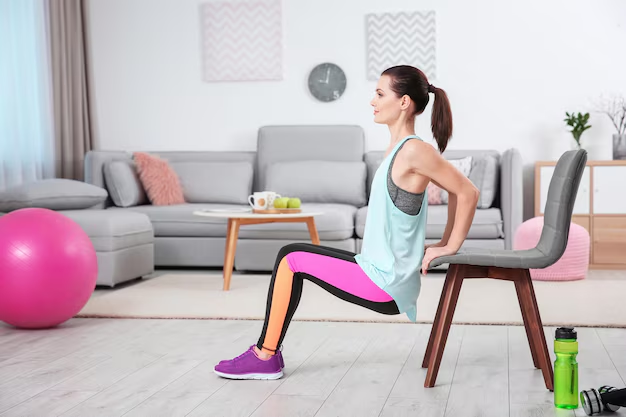
| Tricep dips (floor) | 45 seconds | Arms |
| Jumping jacks or step jacks | 45 seconds | Cardio |
Rest 60���90 seconds between rounds, then repeat 2–3 times depending on your fitness level. The right number of rounds depends on where you're starting from — someone newer to exercise may complete one or two full rounds and feel appropriately challenged, while a more experienced person might push through three.
3. Cool-Down (5 Minutes)
Cooling down helps your heart rate return to normal gradually and reduces post-workout soreness. Focus on static stretches held for 20–30 seconds each.
Useful cool-down stretches:
- Standing quad stretch
- Seated hamstring stretch
- Child's pose
- Chest opener (hands clasped behind back)
- Seated spinal twist
This phase is often the first thing people skip and one of the more valuable things to protect, especially as workout frequency increases.
Adjusting for Your Fitness Level
One of the biggest advantages of bodyweight training is how easily exercises can be scaled up or scaled down without any equipment at all. ⚖️
Making Exercises Easier
- Push-ups: Drop to your knees or elevate your hands on a countertop
- Squats: Reduce depth or hold onto something for balance
- Lunges: Shorten your stride or eliminate the step entirely
- Plank: Hold from your knees instead of your toes
Making Exercises Harder
- Push-ups: Elevate your feet, slow down the tempo, or add a pause at the bottom
- Squats: Add a jump at the top (jump squats), or slow the descent to a 3–4 count
- Lunges: Add a jump switch between legs
- Plank: Add shoulder taps or extend one arm and the opposite leg
The right difficulty level is one where the last few reps of each set feel genuinely challenging but your form doesn't break down. Form always comes before intensity — a sloppy rep at high speed does less good than a controlled rep at moderate speed.
What This Kind of Workout Actually Trains
Bodyweight workouts aren't just for beginners. Depending on how they're structured, they can target:
- Muscular endurance — the ability of a muscle to sustain repeated contractions over time
- Cardiovascular fitness — particularly when rest periods are short or movements are explosive
- Functional strength — the kind of strength that translates to everyday movement
- Core stability — nearly every bodyweight movement requires some degree of core engagement
What bodyweight training is less suited for is building maximum muscle mass or raw strength, because progressive overload (the gradual increase in resistance that drives muscle growth) is harder to apply without added weight. That said, many people are surprised by how much strength and definition they can develop through consistent, progressive bodyweight training before they hit that ceiling.
Common Mistakes That Limit Results
Even a good routine can underperform if a few key things go wrong:
Skipping the warm-up. Cold muscles are less efficient and more prone to strain. Five minutes at the start changes the quality of everything that follows.
Keeping the same routine indefinitely. Your body adapts. If you've been doing the same circuit for months without it feeling any harder, it's probably time to increase reps, reduce rest, add more complex variations, or adjust the format.
Inconsistent effort. Thirty minutes of going through the motions is not the same as 30 minutes of focused, intentional effort. The quality of attention you bring matters.
Neglecting rest days. Muscles grow and recover between sessions, not during them. How many rest days you need depends on your intensity level, age, sleep, and overall training load — but training every single day without recovery built in tends to produce diminishing returns over time.
How Often and What to Expect 💪
Most fitness guidance suggests that adults benefit from muscle-strengthening activity on two or more days per week, alongside cardiovascular activity. A 30-minute bodyweight circuit can serve both purposes, depending on how it's structured.
Results — in terms of visible changes to strength, body composition, or endurance — vary widely based on factors like starting fitness level, diet, sleep quality, age, consistency, and overall lifestyle. People who are newer to structured exercise often notice changes more quickly. Those who are already fairly active may need more variety or progression to keep seeing adaptation.
What stays consistent across most situations: showing up regularly matters more than any single workout being perfect.
Putting It Together
A 30-minute no-equipment workout is built on five things: a proper warm-up, purposeful exercise selection, a structure that keeps you moving, scaling that matches your current ability, and a real cool-down. The exercises themselves are secondary to how honestly and consistently the framework is applied.
What works best for you — which exercises, which format, which intensity — depends on your current fitness, any physical limitations, and what your body responds to. That's something you'll learn by doing, adjusting, and paying attention over time.